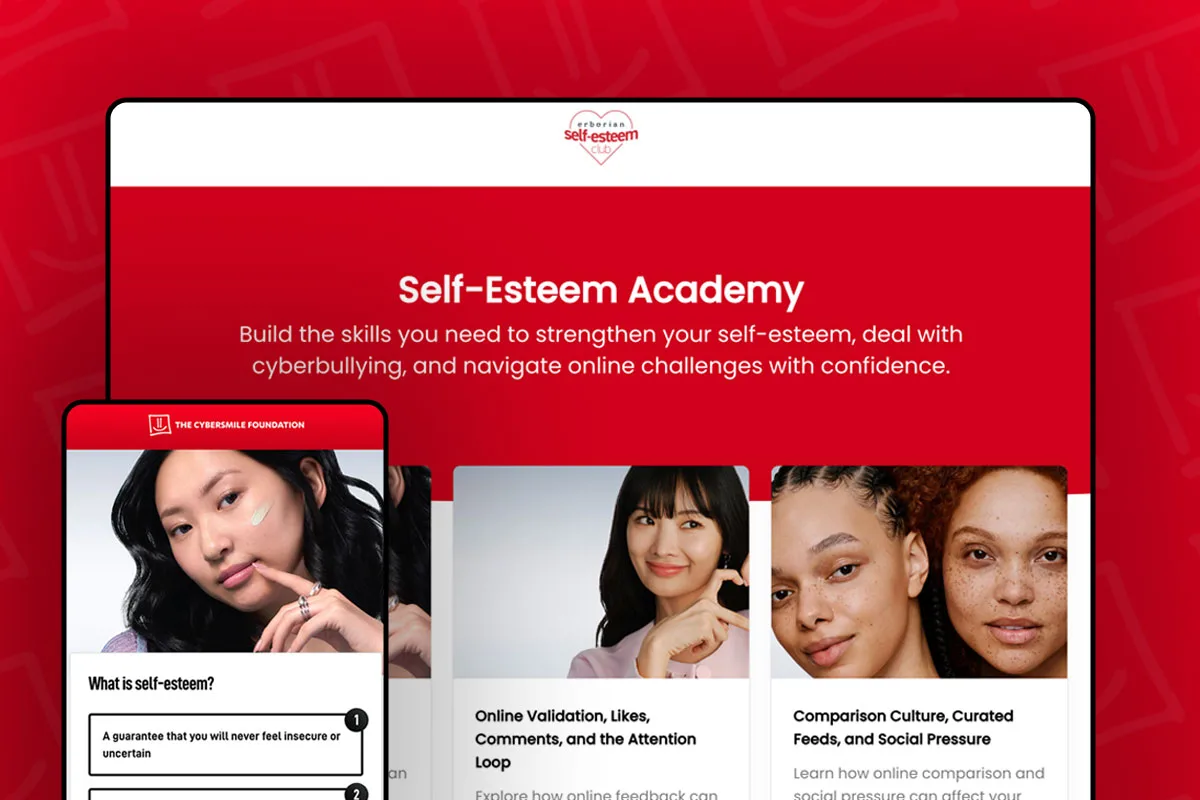
We are proud to announce the launch of the Cybersmile x Erborian Self-Esteem Academy, a new interactive learning experience designed to help people develop practical skills to stay safe online and deal with the pressures that can affect their self-esteem.
Created as part of Cybersmile's ongoing partnership with Korean skincare brand Erborian, the academy consists of six interactive learning modules covering topics including cyberbullying, self-esteem, social comparison, digital confidence, and positive online habits.
With the rise of social media and internet use, cyberbullying has become a more common online experience that can deeply impact one's self-esteem. Erborian is dedicated to helping individuals feel good in their skin and is proud to partner with The Cybersmile Foundation to help combat cyberbullying and support stronger self-esteem for all.
Dorothée Massoulier, CEO, Erborian
The curriculum has been developed by Cybersmile's education and online safety experts using findings from Likes and Lows 2026, the research launched by Cybersmile and Erborian earlier this year. The study explored how cyberbullying, social media interactions, comparison, and other online experiences can influence the way people feel about themselves.
Conducted with 1,000 nationally representative US respondents, Likes and Lows 2026 found that 69% said their opinion of themselves depends on what other people think. More than one-third (34%) had experienced cyberbullying or abuse online. More than half (58%) said social media interactions affect how they feel about themselves, while 66% said they compare themselves to people or lifestyles they see on social media. More than half (60%) said content they see online negatively affects their self-esteem.
These findings helped us identify some of the behaviors, pressures, and misconceptions that the new academy needed to address. Rather than developing a general course about confidence, our team used the research as an evidence base for the curriculum, connecting individual findings with learning outcomes and practical situations that people may encounter in their own lives.
When we published Likes and Lows 2026, we didn't want the research to simply tell us there was a problem. We wanted it to help us build the solution. Our new Self-Esteem Academy takes what people told us about their experiences online and turns those insights into practical skills they can use in their everyday lives. We've listened to people's experiences, learned from the research, and used both to create something that can make a real difference.
Scott Freeman, CEO, The Cybersmile Foundation
An interactive curriculum grounded in real experiences
The Self-Esteem Academy has been designed for people of all ages and abilities, with accessible language and practical guidance that can be applied across all aspects of online life.
Each of the six modules combines interactive questions with useful feedback and a scenario-based test. Incorrect answers have also been designed around misconceptions that people may genuinely hold, rather than obviously wrong choices. Learners are encouraged to think about why a particular response may be better and are given a practical takeaway after each question.
The scenario tests place the learner into relatable situations to reinforce the learning outcomes. Example scenarios include someone posting something that receives very little engagement and begins comparing themselves with another person whose post performs better, or how to respond when a friend feels insecure to show their face online without a filter.
Additional scenarios explore dealing with cyberbullying, repeated notification checking, appearance trends, boundaries around scrolling, and supporting others online.
The Self-Esteem Academy modules
Module 1: Self-Esteem, Self-Worth, and Identity in a Connected World
The first module introduces the differences between self-esteem, confidence, and identity while looking at the role external validation can play in how people see themselves.
The module is informed by the Likes and Lows 2026 finding that 69% of respondents said their opinion of themselves depends on what other people think. Learners consider how feedback and approval can influence confidence without allowing a comment, post, achievement, appearance, or difficult moment to become a measure of their value as a person.
The module also introduces practical ways of challenging negative self-talk and encourages learners to recognize that confidence can change and develop over time.
Module 2: Online Validation, Likes, Comments, and the Attention Loop
Likes and Lows found that 58% of respondents said social media interactions affect how they feel about themselves. The second module looks more closely at why visible online feedback can have such a strong emotional pull.
Learners explore approval chasing, repeated notification checking, engagement metrics, posting habits, and responses to comments. The module acknowledges that positive interactions can be enjoyable and meaningful while helping people recognize when their mood or sense of worth is becoming too dependent on reactions from others.
It also explains some of the many factors that can affect engagement, including timing, algorithms, audience behavior, and chance, helping learners see online metrics as limited platform feedback rather than a reliable judgment of themselves.
Module 3: Comparison Culture, Curated Feeds, and Social Pressure
With 66% of respondents saying they compare themselves to people or lifestyles they see on social media, and 60% saying online content negatively affects their self-esteem, comparison is a major focus of the academy.
This module develops media literacy around curated feeds, algorithms, highlight reels, milestones, lifestyle content, and appearance pressure. Learners consider why comparing the full reality of their own life with a selected part of somebody else's can create an unfair benchmark and how repeated exposure to certain types of content may affect mood and self-esteem.
Practical learning includes recognizing when comparison is becoming unhelpful, curating feeds, putting online content into context, and setting goals around personal values and circumstances rather than somebody else's public image.
Module 4: Beauty Standards, Appearance, and Feeling Comfortable in Your Own Skin
The fourth module explores the relationship between beauty, self-image, digital culture, and self-esteem. It covers beauty standards, representation, self-care, and skin confidence.
Beauty content, skincare, makeup, fashion, and other forms of self-expression can be creative, enjoyable, and confidence-building but can also erode self-esteem. Learners are encouraged to think critically about what they see, understand why transparency and representation matter, and approach self-care as something that supports our wellbeing rather than as a requirement to correct perceived flaws.
Likes and Lows 2026 found that 68% of respondents believe beauty brands should support positive self-esteem and confidence. The research also found strong support for brands using their platforms positively and representing a diverse range of people.
Module 5: Cyberbullying, Criticism, and Protecting Confidence Online
Drawing on Cybersmile's expertise in cyberbullying and online safety, Module 5 helps learners recognize harmful online behavior and understand the options available when it happens.
The module covers cyberbullying, harassment, appearance-based abuse, pile-ons, harmful comments, and behavior that may be dismissed as a joke. Learners also consider the difference between constructive criticism and personal attacks intended to humiliate, threaten, or intimidate.
Rather than relying on advice to "just ignore it," the module introduces practical responses, including blocking, muting, restricting, filtering, reporting, saving evidence, and seeking support. It also looks at how to support another person safely, including the importance of respecting their privacy.
Module 6: Digital Confidence, Boundaries, and Positive Online Habits
The final module brings the learning together through practical habits that people can use every day in their online lives.
Learners explore online boundaries, privacy, scrolling and notification habits, feed curation, resilience, support networks, and ways of responding when an online experience continues to affect them after they have left the screen.
Learners finish the module by considering their own self-esteem protection routine and the boundaries, support, and habits that could help them maintain a healthier life online.
Supporting self-esteem through meaningful education
The Self-Esteem Academy is the latest development in Cybersmile and Erborian's partnership to tackle cyberbullying and support stronger self-esteem.
Learners completing the six modules will explore how to respond more safely to cyberbullying, separate online engagement from personal worth, recognize unhealthy comparison, think more critically about curated and edited content, establish healthy boundaries, find appropriate support, and contribute to online spaces in ways that reduce harm.
The Cybersmile x Erborian Self-Esteem Academy is available now.