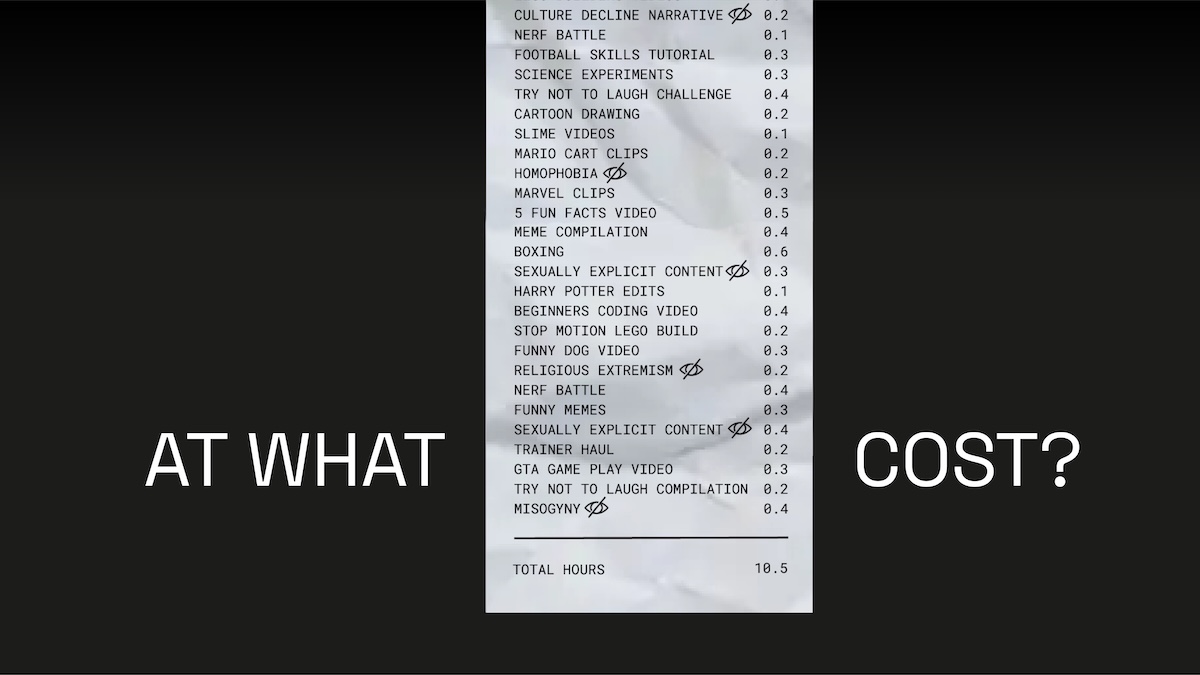
We are proud to announce the launch of 'Stop The Forced Feed,' a new research-based campaign utilizing practical testing, nationally representative research, and engaging creative initiatives to advocate for crucial policy change to safeguard social media users from the potentially harmful effects of social media algorithms.
The data-led initiative includes a powerful creative campaign spearheaded by a new Cybersmile PROTECT manifesto for change. The Personalized Regulation of Tech Exposure & Content Transparency framework calls for regulators and governments to empower social media users with full agency over their algorithmic experiences.
The Algorithm Experiment
Cybersmile volunteers over the age of eighteen, led by behavioral scientists, conducted a guided experiment to test real-world exposure to content suggested by social media platform algorithms. The volunteers found harmful content being served to users within minutes, without them searching for it. It took as little as 16 seconds for adult accounts and 8 minutes for children's accounts to be served harmful content without their consent.
Uncontrollable exposure to harmful content shouldn't be the price that users are required to pay to use social media. We are calling for a transfer of power so that social media users can have complete control over what they are consuming online, in the same way that they can control what they consume in other areas of their lives.
Scott Freeman, CEO, The Cybersmile Foundation
Racism, misogyny, and violence were the most common themes observed in the experiment. This included hateful speech towards different groups and communities, content depicting and encouraging extreme violence, suicidal ideation, content demeaning people with disabilities, and content encouraging dangerous behaviors, all within a three-day testing period.
This was a structured behavioral exposure study designed to observe how platform recommendation systems respond to neutral user behavior, rather than a large-scale prevalence study. Experiment findings include:
The volume of harmful content increased over time. By day three, nearly one in five posts on children's accounts and more than one in three on adult accounts contained harmful material.
Within three days of testing:
- 90 percent of the accounts were exposed to racist content.
- 60 percent of the accounts were exposed to misogyny.
- 60 percent of the accounts were exposed to violence.
- Adult accounts were exposed to more harmful content overall—ranging from 3-34% on day one to 5-38% on day three.
- Child accounts were exposed to less extreme content overall, but the volume ranged from 0-12% on day one to 1-18% on day three.
The UK's Online Safety Act defines harmful content as material that poses a significant risk of physical or psychological harm to users—especially children.
Dr. Jo Hickman Dunne, Research Fellow in adolescent mental health, Manchester University, independently reviewed the study results and commented, "Young people tell us that content they do not want to see makes it into their social media feed. The Stop the Forced Feed campaign effectively highlights that social media systems have been designed to prioritize engagement over well-being. We have the capacity to change this for the well-being of young people and all end-users. Cybersmile's PROTECT framework demonstrates a way to achieve this."
Measuring Public Opinion
Following our practical algorithm experiment to identify risks to social media users, we commissioned a 2000-respondent nationally representative survey to identify public understanding of algorithms and establish appetite for control over algorithmic experiences on social media.
Forced Feed 2026 findings include:
- 65% of social media users would like more control over their algorithmic experiences and the content that they see.
- 69% of social media users would like more insight into how algorithms decide why they see what they see.
- Only 36% of social media users feel in control of their algorithmic experiences.
- 40% of social media users don't understand algorithms.
Stopping the 'Forced Feed' by Turning Data Into Action
To raise awareness of this issue, alongside a number of supporting partners, we have launched AlgorithmTM, the first-ever fictional food brand created to force-feed decision-makers and the public the reality of algorithmic harm*.
Through a range of everyday food items, our research has been brought to life to make the current online environment a tangible reality. Selected food products have been rewrapped to display examples of the harmful content users are routinely fed on social media.
This truth will be served up to policymakers, influencers, and the UK public in the form of a 'food HARMper' containing 'Racist White Bread,' 'Free Range Misogyny,' 'Cream of Violence Soup,' and 'Long-Ingrained Body Shame,' amongst others.
"The AlgorithmTM brand provides a tangible, visceral depiction of algorithmic harm and the nonconsensual nature of it," said Scott Freeman of Cybersmile. "This initiative has been created to draw attention to the stark reality of our social media feeds and to support our crucial campaign for change."
To support the campaign, local Tesco stores have been temporarily transformed to display the fictional AlgorithmTM food brand to raise awareness amongst the broader public about the reality of algorithmic feeds and to garner support for change amongst shoppers.
A Crucial Public Health Issue
Harmful content on social media is widely recognized as detrimental to mental and physical well-being. Widespread exposure has been shown to impact:
- Mental health, including anxiety, poor sleep, depression, and low self-esteem
- Body image and encouraging eating disorders
- Self-harm, suicide, and dangerous practices and 'challenges'
The algorithms, which value engagement often at the expense of user well-being, take over feeds without the user's consent.
The Cybersmile PROTECT Manifesto
In light of our Forced Feed 2026 report findings, we are today launching our transformational PROTECT manifesto, calling on regulators, governments, and social media platforms to enshrine full user control of algorithms as a basic user right.
Cybersmile PROTECT (Personalized Regulation Of Tech Exposure & Content Transparency) offers a user-first solution for algorithmic safety and transparency. You can download the manifesto here.
When we talk about complete control, we don't mean indicating to platforms that we want to see 'less' of certain types of posts or that the user 'dislikes' them: we want to empower users and caregivers with the tools required to protect themselves and those they care for from content that they find harmful without needing to rely on platforms and before harm takes place.
Scott Freeman, CEO, The Cybersmile Foundation
We propose a transfer of power that requires platforms to provide personal user controls over algorithmic content delivery. This change will empower users, not platforms, with the ability to fully moderate their own exposure, ensuring user safety without compromising free speech and open dialogue.
The Cybersmile PROTECT framework builds on the Online Safety Act (UK) and Digital Service Act (EU) by calling for:
- Individual-level algorithmic control, e.g., personal filtering and the option to completely mute topics rather than vague 'see more' or 'see less' indicators.
- Real-time algorithm adjustment in response to user signals, beyond existing bulk or aggregate controls.
- Mandatory inclusion of algorithm tools across both organic and ad feeds.
- While existing laws cover many foundational principles, PROTECT advocates for deeper personalization and legislative mandates to empower user agency at scale.
Cybersmile PROTECT gives everyone, especially vulnerable individuals and caregivers, the power to tailor their online experiences. It places health, dignity, and agency at the heart of our online environments. It is an appropriate and proportionate defense against harm, empowering citizens and aligning with democratic values. A future where humans, not algorithms, decide what they see online is not just possible; it is necessary.
You can learn more about the campaign and how to get involved here.
*AlgorithmTM is a fictional brand name used for illustrative purposes only and is not associated with any actual company or product.