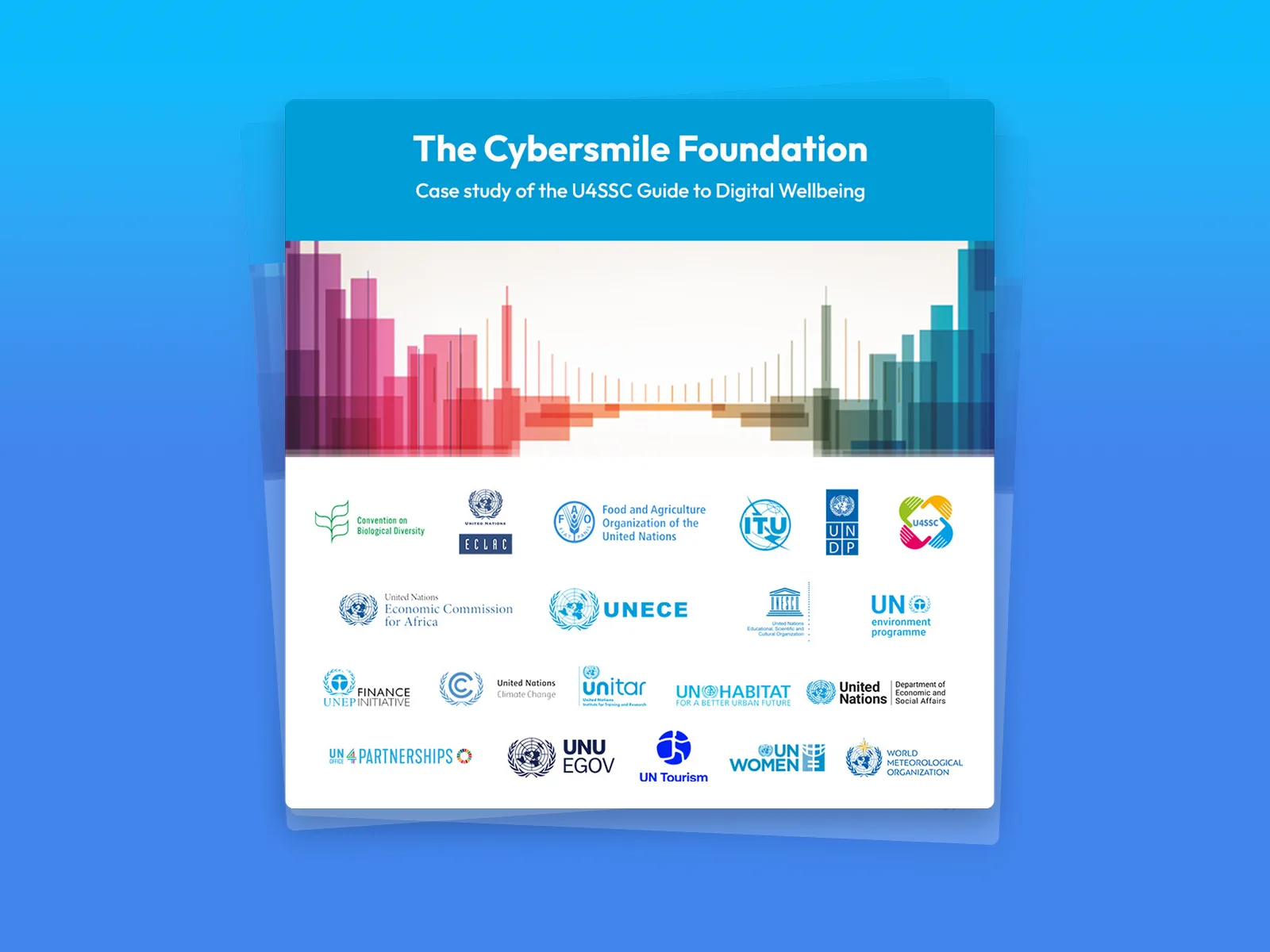
Cybersmile has been independently featured as a case study by the International Telecommunication Union (ITU), a specialized United Nations agency, highlighting the impact of our work in online safety and digital wellbeing. This acknowledgment underscores the effectiveness and global relevance of our integrated approach, which combines awareness, education, and support to address online harm and promote digital wellbeing at scale.
The ITU case study examines how Cybersmile's programs operate within an evidence-based framework that successfully fosters behavioral, cultural, and systemic change. By mapping the pathways through which our initiatives create measurable outcomes, the case study highlights our commitment to preventing harm, supporting individuals, and promoting positive digital behavior.
A central focus of the report is how Cybersmile's model aligns with global priorities in digital wellbeing and online safety. The case study situates our work within the United for Smart Sustainable Cities (U4SSC) initiative, illustrating how our programs contribute to safer, more inclusive digital environments. Additionally, the ITU analysis notes the alignment of Cybersmile's work with the United Nations Sustainable Development Goals (SDGs), particularly SDG 3 (Good Health and Well-Being) and SDG 4 (Quality Education). This demonstrates how our initiatives not only protect individuals but also contribute to broader societal outcomes, such as equitable access to digital resources, education, and health support.
This recognition by a United Nations specialized agency is a significant milestone for Cybersmile, reflecting our position as a trusted global leader in online safety and digital wellbeing. It demonstrates that our integrated approach—combining education, awareness, and support—is not only innovative but also effective, scalable, and aligned with international priorities.
Scott Freeman, CEO, The Cybersmile Foundation
The case study also emphasizes the evidence-based nature of Cybersmile's programs. Our digital support services, including AI-assisted help, interactive education modules, and global awareness campaigns, are designed to provide both immediate support and long-term behavior change. The ITU report recognizes that this combination of research-informed interventions, innovative technology, and educational outreach allows Cybersmile to operate at scale while maintaining effective outcomes.
Importantly, the ITU case study provides an independent evaluation of Cybersmile's methodology and impact. It highlights the strength of our Theory of Change, which demonstrates how our programs lead to measurable impact across behavioral, cultural, and systemic levels. This independent evaluation provides objective insight into the effectiveness of our interventions and the scalability of our model.
For Cybersmile, the ITU feature reinforces our ongoing commitment to innovation and continuous improvement. As online environments evolve, so too does the nature of online harm. Our evidence-based framework allows us to adapt, scale, and refine programs to meet emerging challenges while continuing to produce measurable outcomes. By integrating research, user feedback, and international best practices, we ensure that our work remains both relevant and impactful.
Cybersmile's ITU case study is a testament to our dedication to measurable, evidence-driven impact. By sharing this recognition, we aim to inspire collaboration, inform global practice, and continue driving positive change across digital communities worldwide.
The ITU case study is published under a Creative Commons Attribution-NonCommercial-ShareAlike 3.0 IGO (CC BY-NC-SA 3.0 IGO) license, ensuring it can be shared and referenced responsibly while maintaining proper attribution. Interested partners and funders can view the full case study here.